


Door Closer Prices in India: Best Door Closers for Home & Commercial Use

Introduction
Door closer prices in India range from about ₹490 for a light concealed chain closer to ₹17,499 for a Dorma integrated transom closer. A decent standard arm hydraulic door closer for a 40–60 kg door costs somewhere around ₹900–₹1,300. Concealed door closers run in the range of ₹3,000–₹18,000, and floor springs for glass and wooden/ metal doors ₹3,500–₹12,500. Three variables determine the price: door weight, door closer type, and brand.
This page lists various door closers and floor springs we supply, with current prices to assist you to compare across brands in one place instead of five browser tabs. Prices below are live as of September 2026 and include GST.
Door Closer Price List in India, 2026
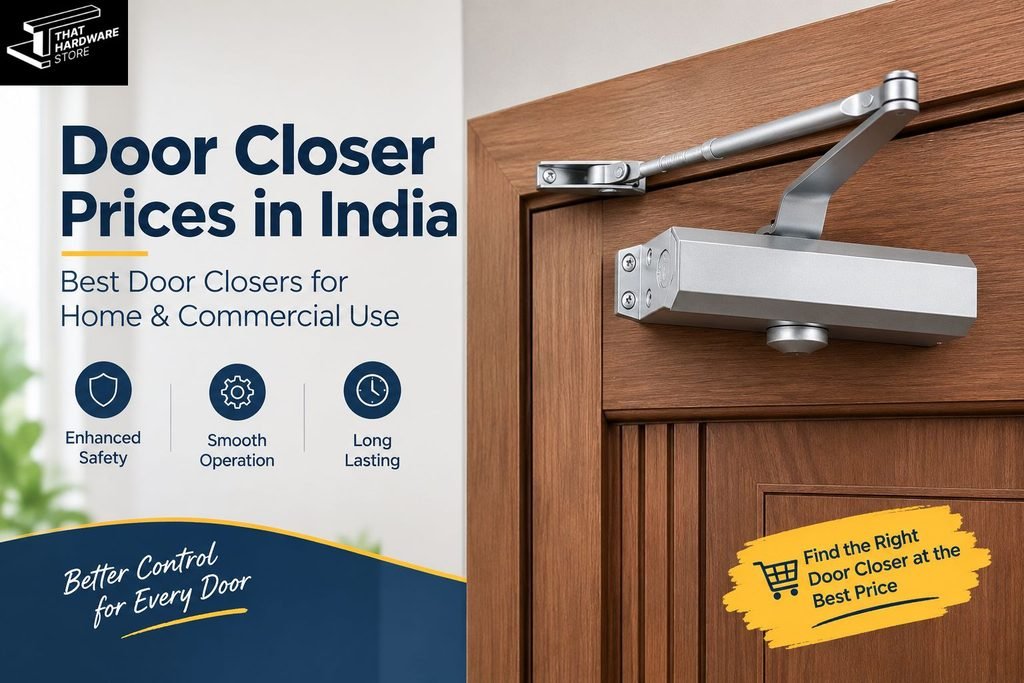
The everyday door closer uses a hydraulic body with a scissor arm. Install the body on the door face and connect the arm to the frame. You will find this type of door closer in most homes, offices, shops, and clinics. Browse the full range on our standard arm door closers page.
Surface-Mounted Standard Arm Door Closers
Pelmet Arm Door Closers
Concealed Door Closers
| Product | Door weight | Price | MRP |
| Concealed Chain Door Closer — Sris Ma Fils | up to 45 kg | ₹490 | ₹710 |
| Ozone Concealed Door Closer CDC-3800 E | medium doors | ₹3,847 | ₹6,270 |
| Dorset Concealed Door Closer DC-40 CO | up to 40 kg | ₹4,299 | ₹6,150 |
| Dorset Concealed Door Closer DC-65 CO | up to 60 kg | ₹4,599 | ₹6,570 |
| Dorset Concealed Door Closer DC-85 CO | up to 80 kg | ₹4,799 | ₹6,930 |
| Ozone Concealed Door Closer CDC-3800, Black | medium doors | ₹4,897 | ₹7,980 |
| Ozone Concealed Door Closer CDC-6800 TA | heavy doors | ₹8,274 | ₹13,485 |
| Dorma Kaba Door Closer ITS-96 | up to 80 kg | ₹17,499 | ₹23,168 |
The ITS-96 is a commercial-grade unit that sits entirely inside the door leaf with the arm channel in the transom. It is what specifiers use on hotel, hospital and office fire doors where the closer must be invisible and must still meet an EN power rating.
Floor springs for glass doors — ₹3,559 to ₹12,333
A floor spring is not a door closer variant — it is a different device. A floor spring sits inside the floor and supports the door’s weight while closing it. This makes it the ideal choice for frameless glass doors. You can also use floor springs with wooden and metal doors. See all floor springs.
| Product | Price | MRP |
| Ozone Floor Spring Complete Set FS-6600 | ₹3,559 | ₹5,800 |
| Dorset Floor Spring Complete Set CS 80 | ₹5,218 | ₹7,370 |
| Dorset Floor Spring Complete Set CS 80 WL | ₹6,999 | ₹9,885 |
| Ozone Floor Spring Complete Set FS-8400 | ₹8,486 | ₹13,800 |
| Ozone Floor Spring Complete Set FS-9400 | ₹9,449 | ₹15,400 |
| Dorset Floor Spring CS 100 WL | ₹9,512 | ₹13,435 |
| Ozone Floor Spring Complete Set FS-8400 S | ₹9,634 | ₹15,700 |
| Ozone Floor Spring Complete Set FS-11400 | ₹12,333 | ₹20,100 |
Prices updated September 2026. We revise this page monthly.
What decides the price of a door closer
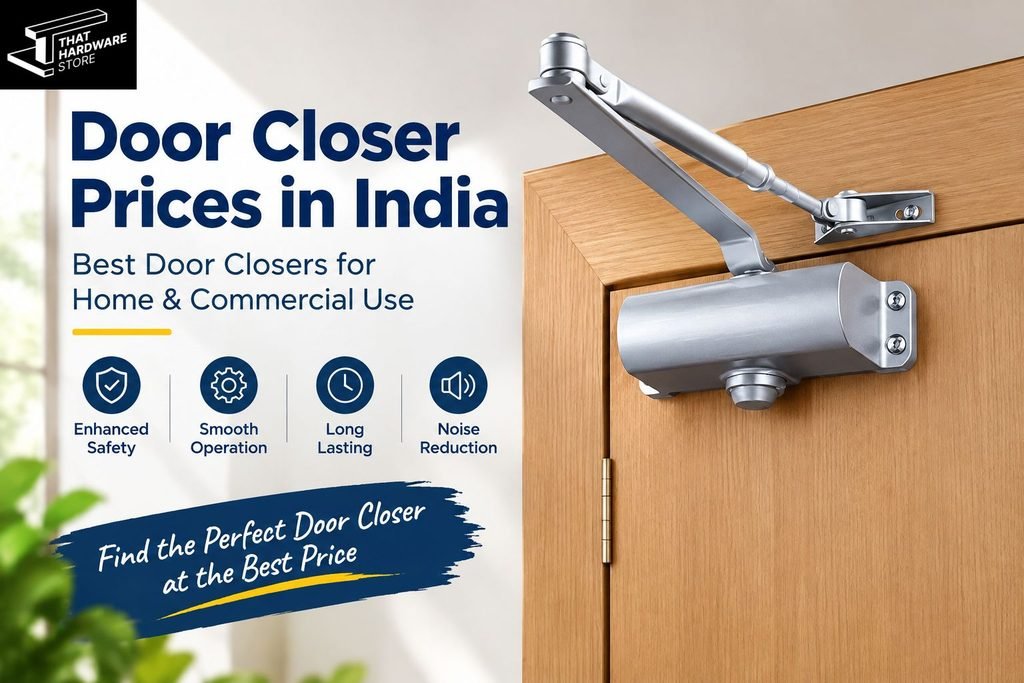
Three things, in order of how much they move the number.
1. Door weight. A closer rated for 80 kg needs a larger cylinder, more oil and a stronger spring than one rated for 40 kg. Within the same brand and range, moving from a 40 kg to an 80 kg rating roughly doubles the price — the Dorset DC-40 is ₹1,042 and the DC-80 PDC is ₹2,099.
2. Where the mechanism sits. Surface-mounted is cheapest because it is the simplest to make and to fit. Concealed costs three to four times as much for the same door weight — Dorset’s DC-40 is ₹1,042 on the surface and ₹4,299 concealed — because the body has to be smaller, sealed against dust, and engineered to work through a morticed channel. Floor springs cost more again because they also bear the door’s weight.
3. Brand and where it is made. A German-engineered Dorma unit and an Indian-made Safezone unit at the same door rating can differ by three times. What you are paying for is the seal quality and the oil, which is what decides whether the closer still works properly in year five or starts weeping oil and slamming in year two.
Types of door closer, and which door each one suits
Surface-mounted / standard arm
Body on the door, scissor arm to the frame. The default. Cheapest to buy, quickest to fit, easiest to adjust or replace later because everything is accessible. The arm is visible, which is the only real objection to it.
Pelmet arm / slide arm
Body on the door, arm running in a track on the frame. Nothing sticks out into the opening, so it looks tidier and cannot be grabbed or swung on. Useful under pelmets and false ceilings, and the usual choice on heavier doors — the Safezone units here take up to 90 kg.
Concealed
Morticed into the door leaf, invisible when shut. Specified on architectural and hotel work. The trade-off is that fitting requires accurate routing, and any future servicing means taking the door off.
Concealed chain closer
A simple spring-and-chain unit, not a hydraulic one. At ₹490 for up to 45 kg it is by far the cheapest way to make a light internal door self-closing. It will not give you controlled, cushioned closing — it pulls the door shut and that is all. Fine for a store room, wrong for a main door. It is especially suited for jalli (netted) doors.
Floor spring
Set into the floor, carries and closes the door. Required for frameless glass doors and used on heavy timber entrance doors. Needs the floor to be cut before the flooring goes down, so it has to be decided early in a build, not retrofitted.
How to choose a door closer by door weight
This is where most wrong purchases happen. Door closers are sized to the door, and the sizing is standardised.
In India the relevant standard is IS 3564: Hydraulically Regulated Door Closers, published by the Bureau of Indian Standards. It defines three sizes:
| IS 3564 size | Door mass | Door width | Typical use |
| Size 1 | up to 35 kg | up to 700 mm | Lightweight doors such as toilet doors |
| Size 2 | 36–60 kg | 701–850 mm | Interior doors — bedroom, kitchen, store |
| Size 3 | 61–80 kg | 851–1,000 mm | Main and entrance doors |
Imported and premium units are usually marked instead with an EN power size under BS EN 1154, which runs from 1 to 7:
| EN power size | Max door width | Test door mass |
| EN 1 | under 750 mm | 20 kg |
| EN 2 | 850 mm | 40 kg |
| EN 3 | 950 mm | 60 kg |
| EN 4 | 1,100 mm | 80 kg |
| EN 5 | 1,250 mm | 100 kg |
| EN 6 | 1,400 mm | 120 kg |
| EN 7 | 1,600 mm | 160 kg |
That is why the Dorma ITS-96 above is marked EN 2–4: it is adjustable across that range, covering doors from roughly 40 kg to 80 kg.
Practical picks by weight
- Up to 40 kg — a light internal door, bathroom or bedroom door in a flat. Dorset DC-40 at ₹1,042, or the Dorset DC-40 CO at ₹4,299 if it must be hidden.
- 40–60 kg — the most common case in Indian homes: a standard flush or panelled door. Dorset DC-60 ₹1,220, Ozone Speedy DC-60 ₹899, or Safezone DC-60 ₹899.
- 60–80 kg — a solid wooden main door, a heavy laminated door, or an office entrance. Dorset DC-80 PDC ₹2,099 or Dorma Kaba TS-68 ₹3,499.
- 80–90 kg, or a wide or wind-exposed door — use a pelmet arm. Safezone Pelmet Arm ₹2,200 or Dorset DC-80 Ext. WP ₹3,699.
- Glass doors — a surface closer will not work. Use a floor spring, starting at Ozone FS-6600 ₹3,559.
Two rules that save returns. Always round up, never down — an under-rated closer runs at full spring tension permanently, wears out early and slams. And measure the door leaf width as well as the weight: both the IS and EN tables are width-and-mass tables, and a wide door needs a higher size than its weight alone suggests, because the leverage is worse.
Door closers for wooden doors
Most Indian residential main doors are solid or engineered timber somewhere between 45 kg and 75 kg, which puts them in IS 3564 Size 2 or Size 3. A 35 mm flush door of 900 mm width is typically 40–55 kg; a 45 mm solid teak or engineered main door of the same width can reach 70–80 kg.
For a wooden door, three things matter beyond the weight rating:
- Screw purchase. Timber holds a closer better than a hollow flush door. If the door is hollow-core, fit the closer over the internal rail, not the middle of the panel — the screws will pull out otherwise.
- Backcheck. On a main door that opens outwards into a corridor or a windy balcony, backcheck resistance stops the door being flung open and the hinges being wrenched. The Dorma and Ozone units above have it; the entry-level ones do not.
- Delayed action. Useful on a door people carry things through — it holds the door open a few seconds before closing. Worth having on a kitchen or utility door.
Pair the closer with the right hinges — see our ball bearing butt hinges, which are what you want on any door heavy enough to need a closer.
Door closers for aluminium and glass doors
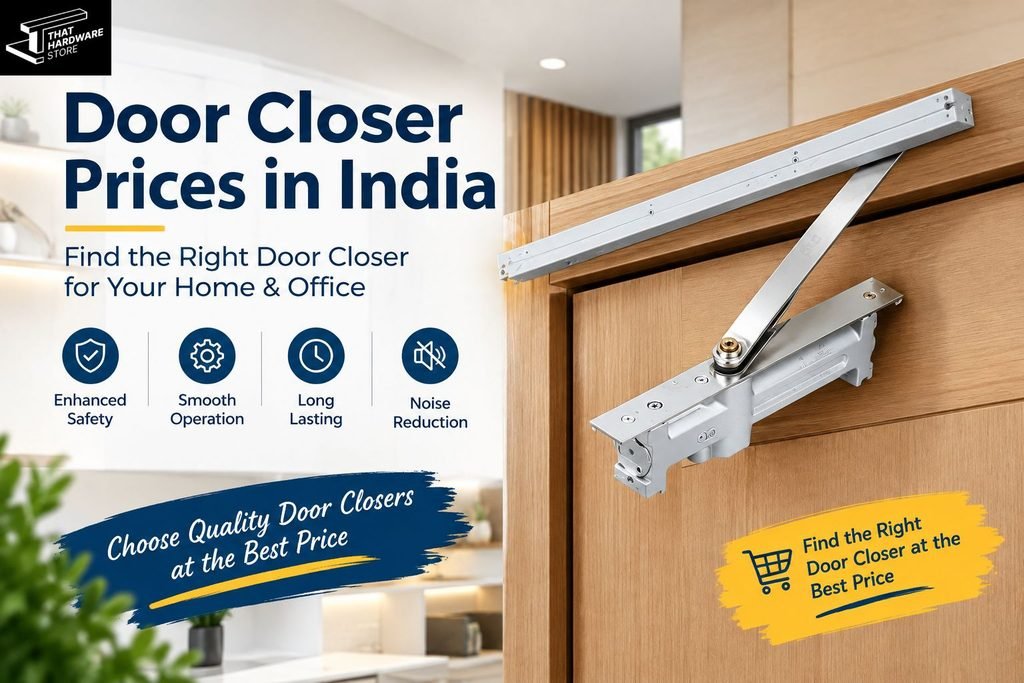
Aluminium doors are lighter than timber but have thin sections, so the fixing matters more than the rating. Use a closer with a plate fixing rather than direct screws into the extrusion, and check the top rail is deep enough for the body — a narrow-stile aluminium door often is not, which is when a pelmet arm or a transom-mounted unit becomes the answer.
Frameless glass doors cannot take a surface closer at all: there is nothing to screw into. They need a floor spring with a matching top and bottom patch fitting. Framed glass doors in an aluminium or steel frame can sometimes take a transom closer instead, which is cheaper than cutting the floor.
Hydraulic, pneumatic and “automatic” — what the words actually mean
Hydraulic means the closing speed is controlled by oil pushed through valves. Nearly every door closer sold in India, including all of the ones above, is hydraulic. When someone says “hydraulic door closer” they usually just mean a proper door closer, as opposed to a spring hinge.
Pneumatic closers use air instead of oil. They are the light plastic-bodied units used on screen doors and cupboards. Cheaper, much less controlled, and not suitable for a main door.
Automatic door closer is the phrase most Indian buyers search for, and it usually means exactly the same thing as a hydraulic door closer — a device that closes the door by itself. It does not mean a powered or sensor-operated door. If you want a door that opens by itself, that is an automatic door operator, a different and far more expensive product.
Concealed door closers: when the extra cost is worth it
A concealed closer costs roughly four times its surface equivalent. It is worth it in three situations:
- The door is a design feature. On a veneered or designer main door, a surface closer and arm visibly interrupts the face. This is the usual reason.
- The closer would get knocked. In tight corridors and narrow entries, a projecting arm gets caught on furniture and shoulders.
- Tamper resistance matters. In rented or shared premises, a concealed unit cannot be casually unscrewed or adjusted.
It is not worth it if the door will ever be serviced by a general handyman, or if the door is already hung — retrofitting a concealed closer to an installed door means routing the leaf and frame in place, which is difficult to do cleanly.
Brand comparison: Dorma, Dorset, Ozone, Safezone and Royal Art
| Brand | Price range here | Where it fits |
| Dorma Kaba | ₹899 – ₹17,499 | German engineering, the widest price span. The Aido XLC line is the accessible range; TS-68 and ITS-96 are specification-grade for commercial and fire doors. |
| Dorset | ₹1,042 – ₹9,512 | The dependable middle. Clear weight ratings across surface, pelmet and concealed, plus floor springs. The default choice for most residential projects. |
| Ozone | ₹899 – ₹12,333 | Strongest on concealed closers and floor springs. The CDC and FS ranges are what most glass-door and architectural jobs in India get fitted with. |
| Safezone | ₹899 – ₹2,699 | Value end, and the only brand here offering 90 kg pelmet arm units at around ₹2,200. Also the widest finish choice — antique and black as well as standard. |
| Royal Art | ₹899 | Single 60 kg surface unit at the entry price. Fine for a store room or a back door; not what to specify on a main entrance. |
If you are buying in quantity for a project or a site, our bulk order page has trade pricing.
Installation and adjustment basics
Every hydraulic closer here has at least two adjustment valves, usually marked S and L: S (sweep) controls speed from fully open down to about 15 degrees, and L (latch) controls the final few degrees that push the door into the latch. Better units add a third valve for backcheck and sometimes a fourth for delayed action.
Three things worth knowing before you fit one:
- Adjust in quarter turns, and never more than two full turns out. Backing a valve out too far can push the pin past its seal, and that is how a closer starts leaking oil.
- Set latch speed faster than sweep speed. A door that drifts slowly into the frame will not engage the latch, and the owner will conclude the closer is faulty.
- Check the closing force after the monsoon. Oil viscosity changes with temperature, so a closer set perfectly in January can be sluggish in July. A quarter turn is usually all it needs.
Related reading
- All door closing systems — the full range, filterable by type and brand
- Floor stoppers: types, uses and buying guide — what to fit alongside a closer so the door does not hit the wall
- Top door lock brands in India
- Best main door locks in India
- Door hinges — sizes and types
Frequently asked questions
Door closer prices in India range from ₹490 for a light concealed chain closer to ₹17,499 for a commercial integrated transom closer. The most common purchase, a hydraulic surface closer for a 40–60 kg residential door, costs ₹900 to ₹1,300. Concealed closers cost ₹3,800 to ₹8,300 and floor springs ₹3,500 to ₹12,500.
For an Indian residential main door of 60–80 kg, a Size 3 surface closer is the standard answer: the Dorset DC-80 PDC at ₹2,099 or the Dorma Kaba TS-68 at ₹3,499. Choose the Dorma if the door is exposed to wind and you want backcheck. If the door must stay visually clean, the Dorset DC-85 CO concealed unit at ₹4,799 does the same job out of sight.
Measure the door’s weight and its leaf width, then match both against the IS 3564 table: Size 1 up to 35 kg and 700 mm, Size 2 for 36–60 kg and 701–850 mm, Size 3 for 61–80 kg and 851–1,000 mm. If the weight suggests one size and the width another, take the larger. Never size down.
A door closer only closes the door; the hinges carry its weight. A floor spring is set into the floor and does both — it carries the door and closes it. Floor springs are used for frameless glass doors, which have no frame to hinge from, and for very heavy entrance doors. They cost more and must be planned before the flooring is laid.
A correctly sized hydraulic closer on a residential door should run five to ten years before the seals begin to weep. The two things that shorten that dramatically are under-sizing — fitting a 40 kg unit to a 70 kg door — and over-adjusting the valves. A closer that starts slamming or leaking oil is at the end of its life and is not worth repairing.
A surface-mounted or pelmet arm closer can be retrofitted to almost any hung door in under an hour. A concealed closer generally cannot be retrofitted cleanly, because the leaf and frame have to be routed accurately, which is much easier on the bench before hanging. Floor springs cannot be retrofitted without lifting the flooring.